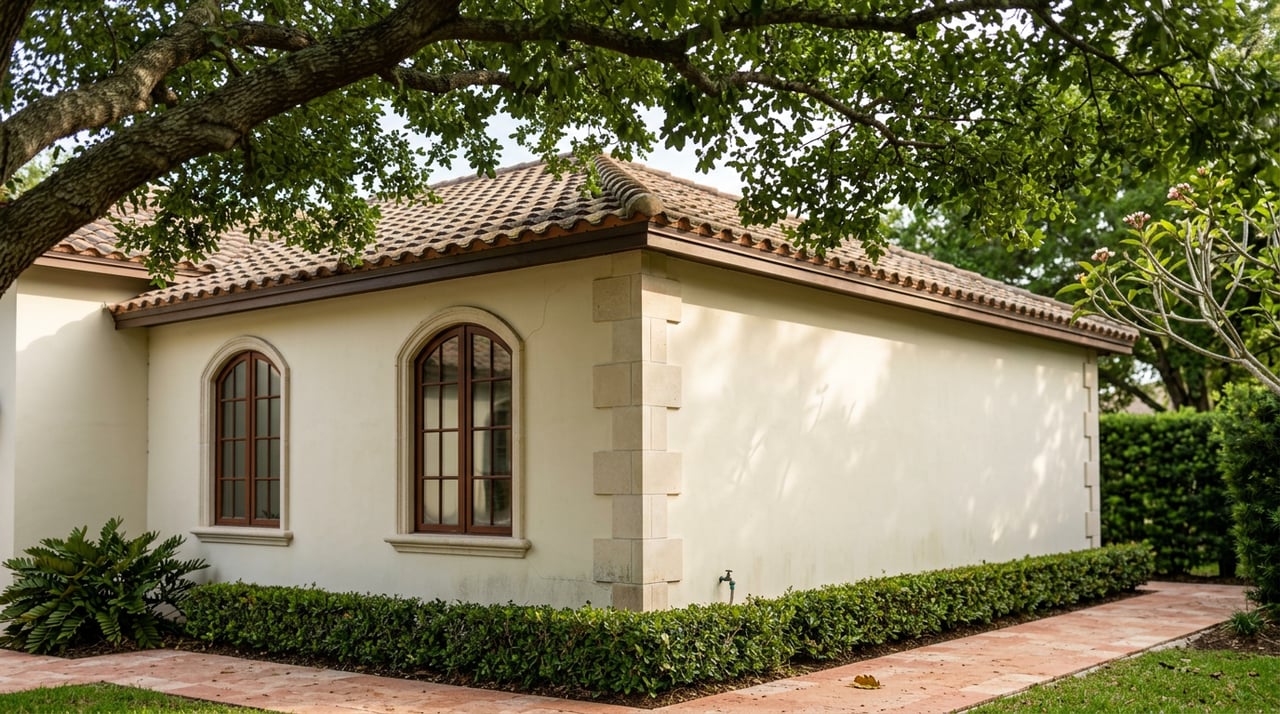
A buyer touring Seasons on a Saturday in June 2026 is almost certainly touring Lotus Edge that same weekend. One home was finished in 1990 on Millionaire's Mile at Clint Moore and Jog. The other is a GL Homes new-construction release a few miles west, priced from roughly $1.7M to $3M, with a 39,000-square-foot clubhouse that opened last year. Both showings will end with the buyer's agent asking the same question: what does this money actually buy.
That question is the reason listings in Seasons have been sitting. As of late June 2026, five homes were active in the community, with an average of 116 days on market and a $2.525M median list price at roughly $633 per square foot. Those are not distressed numbers. They are the numbers a market produces when a 35-year-old home is being compared, showing for showing, against a brand-new one at overlapping price points. The good news for sellers is that most of the gap is not architectural. It is a punch list.
What 116 days on market is actually telling you
Long days on market in an established community usually get blamed on price. In Seasons, price is a symptom. The three homes carrying the longest tallies in early summer 2026 were sitting between roughly $2.0M and $2.53M, which is the same band where a buyer can pick a floor plan at Lotus Palm resale (12-month median around $1.93M) or reserve a lot at Lotus Edge and choose finishes at the design studio.
The Seasons seller is not competing against the Seasons median. The seller is competing against a Bali or Fiji floor plan that has never been lived in, on a lot the buyer helped pick through a GL Homes lottery. Days on market lengthen when the marketing package treats the home like a Seasons comp rather than a Lotus alternative.
What a buyer just saw across town
Before that buyer walks through the door, it helps to know what they saw. Lotus Edge is delivering ultra-contemporary elevations with an in-house Options Coordinator, a spherical water feature at the gate, a cold plunge pool, Bloom's restaurant and bar, a splash park, a teen room, and an indoor kids zone. The estimated HOA runs around $700 per month. Lotus Palm, sold out on new construction, keeps trading resale in the $1.6M to $3.1M range with a median association fee near $652.
Seasons answers with different strengths. Eight Har-Tru clay courts and a tennis program that actually runs leagues. Pickleball. A renovated clubhouse with a Precor fitness room. Lot sizes and mature landscaping that no 2026-delivery community can duplicate. Guard-gated entry with rover patrol. A location inside the Boca 33496 zip and half a mile from Addison Reserve and Polo Club without paying for either. Those are real. They are not enough on their own. A seller who does not translate them into the buyer's frame gives up ground before the first showing.
The 1989/90 punch list buyers price against
Most of the DOM gap closes with condition items a buyer will otherwise price into the offer. In order of what tends to move the needle:
- Roof age and documentation. A home built in 1989 or 1990 is on its second or third roof. Buyers and their insurance carriers want a wind mitigation form and a permit trail. A recent Seasons listing on the market showed a 2018 roof paired with 2019 and 2022 AC replacements and a 2024 tankless water heater. That is the updated stack the current buyer expects at $600-plus per square foot.
- Impact glass throughout. Boca Raton sits in Florida's High Velocity Hurricane Zone, which means replacement windows and doors have to meet impact-rated standards at installation. Full opening protection commonly qualifies for 10 to 45 percent premium discounts depending on the carrier and scope. In a market where Boca homeowners are paying around $6,077 a year to insure a $300,000-dwelling policy, that documentation carries dollars-and-cents weight in the buyer's math.
- AC, water heater, and pool equipment dates. Buyers now ask for the label photos. Have them ready.
- The courtyard and Villa Monterey layouts. Several Seasons floor plans include detached guest cabanas or kasitas. That configuration is a feature for the right buyer and a friction point for the wrong one. Marketing needs to name the model and target the household that wants the second structure, not hide it in a floor plan blur.
- Kitchens and primary baths. The remodeled comps that closed in Seasons in 2024 and 2025 set the visual bar. An original kitchen will not appraise around it. It will be priced against it.
A Seasons home does not lose to Lotus Edge on architecture. It loses when the seller sends a buyer to Lotus Edge with unanswered questions about a 35-year-old roof, an unknown AC vintage, and a permit history no one has pulled.
What Florida actually requires you to hand over
Florida disclosure has tightened in ways that matter at the Seasons closing table:
- A flood disclosure is required at or before contract execution. The form asks about prior flood damage, flood insurance claims, and flood-related government assistance, and it states that homeowners insurance does not cover flood damage.
- Known material defects that are not readily observable and that materially affect value must be disclosed.
- Documentary stamp tax on the deed runs 70 cents per $100 of consideration outside Miami-Dade, per the Florida Department of Revenue. On a $2.5M sale, that is $17,500 out of the seller's net.
- Permit history is public. Buyers and their attorneys pull it through the City of Boca Raton's eHub system without needing to register. Any unpermitted work on a home built in 1990 will surface. Better to surface it yourself.
None of this is theoretical. It is the paperwork a buyer's attorney is going to work through in the second week of the contract, and it is where deals get renegotiated when a seller is caught flat-footed.
The HOA math that reframes your list price
Sellers sometimes discount their homes to close the gap with Lotus Palm without pricing in the biggest structural advantage Seasons carries against its immediate neighbors. Seasons is non-equity. There is no six-figure buy-in and no mandatory monthly club dues at the level of Addison Reserve, Polo Club, Woodfield, or Broken Sound, where equity contributions and dues can quietly add well over $100,000 to entry cost and $5,000-plus to monthly carry.
That is not a footnote in the pitch. It is the pitch. A buyer choosing between a Polo Club estate at a similar list price and a renovated Seasons home is looking at a materially different total cost of ownership over a five-year hold. Say it clearly in the marketing. Show the math. A Seasons list price at $2.5M is not the same $2.5M a buyer sees inside an equity club, and the buyer needs to be told.
A sequencing question, not a checklist
The instinct on a 1990 home is to renovate everything before listing. That is rarely the right move at this price band. Compass Concierge and a targeted pre-list plan usually beat a top-to-bottom remodel because the buyer at $2M-plus wants to make their own finish decisions anyway. The higher-return moves are the ones that remove buyer objections rather than impose taste: permit reconciliation, roof and mechanical documentation, impact-glass verification, a professional pre-inspection, and a cosmetic refresh limited to paint, landscaping, and one or two rooms that photograph the home into the same visual tier as the Lotus resale comps.
Sequence matters. Pull the permits first. Order the wind mitigation and four-point next. Decide on cosmetic scope only after you know what the paper trail is going to say.
FAQ
Is Seasons a good market to list in during summer? Summer is quieter than the November-through-April window, which favors sellers who use the extra time for prep rather than launching cold. A polished listing that goes live in early fall reaches the seasonal buyer pool with a full disclosure and permit package already in hand.
Do I need to renovate the kitchen before listing? Not always. The right answer depends on what the last three Seasons comps at your price point looked like and what your specific model rewards. A pre-list walkthrough will identify whether the kitchen is a discount driver or a "buyer's choice" moment you can leave alone.
How do I handle the Lotus Edge comparison in showings? Directly. The buyer has already made the comparison in their head. Address the non-equity structure, the mature landscaping and lot size, the tennis program, and the Central Boca location on the first page of the marketing, then let the home speak.
Selling a 1990 home in a 2026 market rewards preparation more than it rewards price cuts. If you own in Seasons and want a clear read on which items on the punch list actually move your net, Raihan Mustafa is glad to walk the property, pull the permit history with you, and put a sequenced plan together before the sign goes up. Let's connect.
